

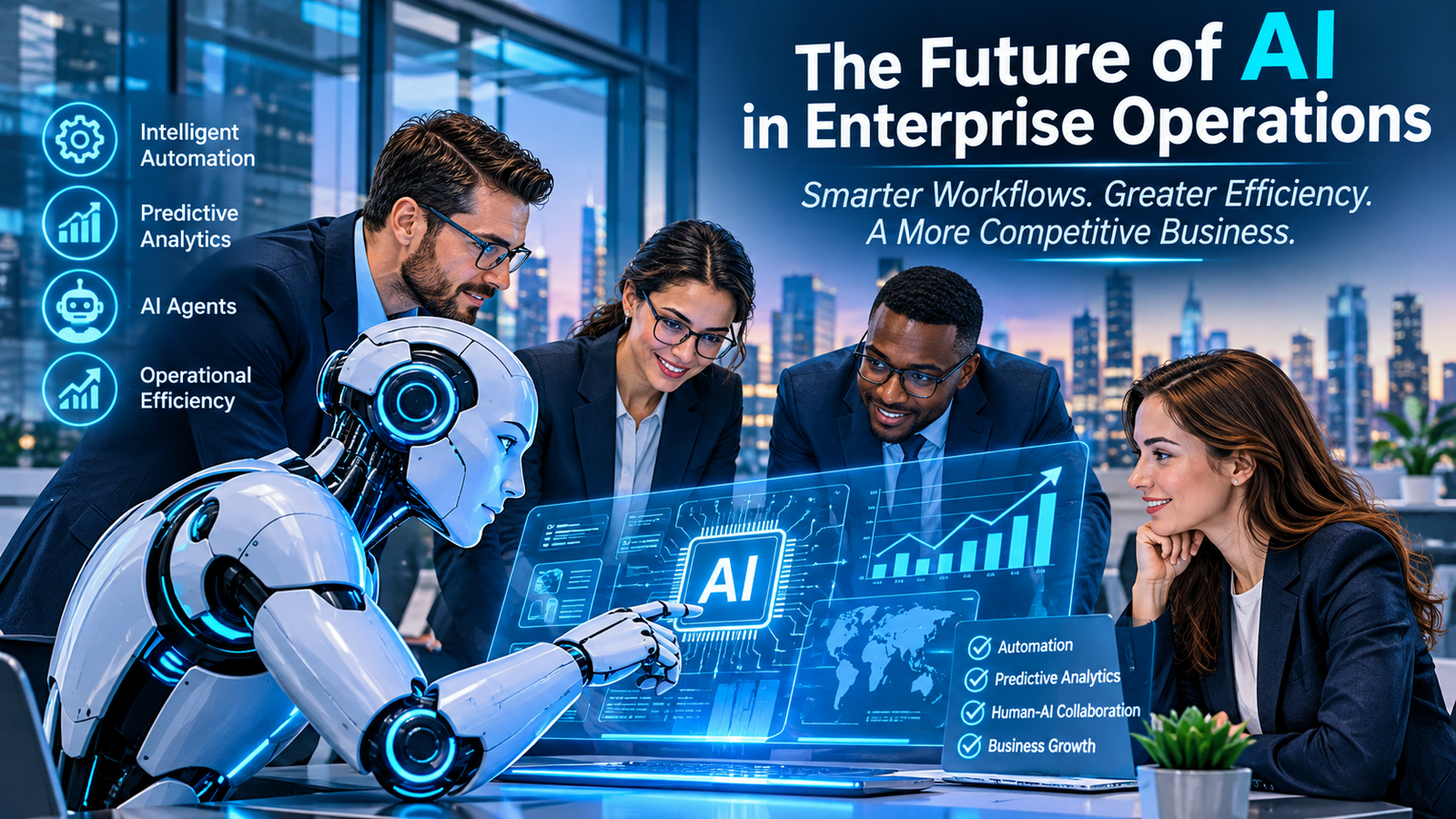

Introduction: The Next Era of Enterprise Operations
Artificial intelligence is transforming the way businesses operate. What began as experimentation with isolated AI tools has evolved into a broader shift toward intelligent, connected, and increasingly autonomous business processes.
In 2026, organizations are moving beyond traditional automation toward systems that can analyze information, support decisions, coordinate workflows, and respond to changing operational conditions.
The competitive question is no longer simply whether companies should adopt AI. It is how effectively they can integrate it into their core operations while maintaining security, accountability, and human oversight.
1. From Traditional Automation to Intelligent Operations
Traditional business automation depends largely on predefined rules and repetitive instructions. Although effective for predictable tasks, these systems often struggle when circumstances change or decisions require contextual understanding.
AI introduces a more flexible approach. By combining machine learning, natural language processing, predictive analytics, and intelligent automation, organizations can build workflows that adapt to new information.
This transition is particularly important in complex business environments, where operational efficiency depends on the ability to connect data, people, and systems.
2. The Key Technologies Driving Enterprise AI
Several technologies are shaping the next generation of enterprise operations:
Intelligent Process Automation: AI can help automate document processing, customer inquiries, administrative tasks, and routine workflows. This allows employees to dedicate more time to complex responsibilities and strategic activities.
Predictive Analytics: By analyzing historical and real-time data, AI systems can identify patterns, forecast demand, detect potential disruptions, and support more informed business decisions.
AI Agents and Workflow Coordination: AI agents are increasingly being developed to perform multi-step tasks, interact with business applications, and coordinate processes. However, their reliability depends on the quality of data, task complexity, and appropriate human supervision.
Human-AI Collaboration: Rather than eliminating the need for human expertise, effective enterprise AI combines computational capabilities with human judgment, experience, and accountability.
3. How AI Is Transforming Major Industries
The impact of AI extends across nearly every major economic sector.
Manufacturing: AI-powered systems support predictive maintenance, quality inspection, production planning, and supply chain optimization. These capabilities can reduce downtime and improve operational efficiency.
Financial Services: Financial institutions use AI to support fraud detection, risk assessment, customer service, compliance monitoring, and financial forecasting.
Healthcare: AI can assist with medical image analysis, administrative workflows, resource allocation, and clinical decision support. Its use must remain subject to professional judgment, patient safety, and applicable regulations.
Logistics and Supply Chains: Predictive systems help organizations forecast demand, optimize delivery routes, manage inventory, and respond to disruptions across global supply networks.
Customer Experience: Conversational AI and intelligent support systems can provide faster responses, personalize services, and help businesses manage large volumes of customer interactions.
4. The Challenges of Enterprise AI Adoption
Despite its potential, integrating AI into enterprise infrastructure presents significant challenges.
Data Security and Privacy: Organizations must protect sensitive information and establish clear rules governing how data is collected, processed, stored, and shared.
Reliability and Accountability: AI-generated decisions can contain errors or reflect biased information. Businesses must establish testing procedures, human review, and clear accountability for consequential decisions.
Legacy Infrastructure: Many organizations operate with outdated systems that are difficult to integrate with modern AI technologies. Successful adoption often requires investment in data infrastructure, cybersecurity, and system modernization.
Workforce Transformation: AI will change the nature of many jobs. Organizations must invest in employee training, digital skills, and workforce adaptation rather than treating automation as a purely technological challenge.
5. AI as a Strategic Business Investment
Enterprise AI should not be treated as a collection of disconnected software tools. Its real value emerges when it becomes part of a coordinated business strategy.
Organizations need to identify operational problems where AI can deliver measurable improvements, establish appropriate governance, and evaluate results against clear performance indicators.
Successful implementation also requires cooperation between executive leadership, technology teams, cybersecurity specialists, and employees.
Companies that focus on practical value, responsible deployment, and long-term integration are more likely to achieve sustainable benefits than those pursuing AI adoption simply for competitive visibility.
6. The Future of Intelligent Enterprise Operations
The next stage of enterprise AI will likely involve deeper integration between AI agents, enterprise software, connected devices, and real-time data platforms.
Businesses may increasingly use coordinated AI systems to support planning, monitor operations, identify emerging risks, and recommend or execute approved actions.
However, greater autonomy does not eliminate the need for human control. High-impact decisions, sensitive operations, and critical business functions will continue to require appropriate oversight, governance, and clear responsibility.
The organizations best positioned for the future will be those that combine technological innovation with sound management and responsible decision-making.
Artificial intelligence is also reshaping the wider global economy, from productivity and employment to international competition. Read our analysis: Artificial Intelligence in 2026: How AI Is Reshaping the Global Economy.
Conclusion: Competing Through Intelligent Transformation
Artificial intelligence is becoming a defining factor in the evolution of modern enterprise operations. Its influence extends beyond productivity improvements to the way organizations make decisions, manage resources, serve customers, and compete in global markets.
Yet technology alone does not guarantee success. The real competitive advantage will come from integrating AI into business strategy, developing skilled workforces, protecting data, and maintaining trust.
The future of enterprise operations will not simply belong to companies that use the most AI, but to those that use it most effectively and responsibly.
References and Further Reading
NIST – Artificial Intelligence Risk Management Framework
OECD – Artificial Intelligence
World Economic Forum – Artificial Intelligence
[…] For a closer look at how these technologies are transforming business processes, explore our analysis of The Future of AI in Enterprise Operations.https://nexusglobaldigital.com/the-future-of-ai-in-enterprise-operations/ […]